top of page

CDA AFTER THE REIGN  //  COEUR D'ALENE, IDAHO

Couer d ' Alene After the Reign

A Vision for Post-Oil Suburbia


In 2010, the world quietly crossed a historic threshold: the global peak of oil production. Since that moment, we’ve entered an era not of energy abundance, but of escalating adaptation. As fossil fuel supplies steadily decline, and global demand surges with industrial growth and population rise, the communities most dependent on cheap energy—suburbs—face a fundamental reckoning.


Nowhere is this transformation more palpable than in Coeur d’Alene, Idaho—a city whose development is deeply intertwined with automobile culture, imported resources, and the illusion of limitless mobility. What happens to such a place when the very foundation of its growth—affordable oil—can no longer be taken for granted? This project explores that question, not as dystopian speculation, but as an opportunity for reinvention.


Crisis as Catalyst for Urban Evolution


At $7 per gallon, commuting from the suburban fringe becomes a burden few can afford. What once was a convenience becomes a constraint. And yet, even as the old model breaks down, Coeur d’Alene possesses a quiet reservoir of potential: existing housing stock, strong social ties, and a cultural memory of self-reliance. These elements, so often overlooked, form the foundation for a new kind of suburb—not abandoned, but re-inhabited with purpose.


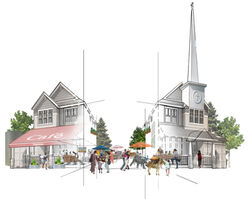
Rather than flee the suburb, we propose its reclamation.In this new vision, transformation begins not with demolition, but with reinterpretation. Single-family homes evolve into multi-generational dwellings. Garages are reborn as workshops and micro-industries. Lawns become gardens; driveways, markets; porches, spaces of public discourse. The suburban house shifts from a private enclosure to a shared platform for community building, resourcefulness, and self-sufficiency.


This is not nostalgia—it’s evolution. An architectural strategy of adaptive reuse gives existing structures new meaning, tethered to changing human needs and environmental limits.

With long-distance trade weakened and imported goods increasingly out of reach, Coeur d’Alene begins to pivot toward a localized, cooperative economy. Backyard food production feeds families and neighbors. Garages house artisan work and repair shops. Neighborhoods develop micro-economies based on exchange, bartering, and mutual support—bicycle repair, fermentation labs, sewing, tool libraries.


Architecture shifts to support this evolution: shared courtyards, open porches, edible landscapes, and mixed-use zoning all foster connection rather than isolation. The once-homogeneous suburban grid becomes a patchwork of creative, productive micro-communities, each adapting to local need while reducing reliance on imported fuel, food, and finance.

This proposal does not dictate a master plan. Instead, it offers a framework for emergent urbanism—a loose scaffolding upon which residents build, adapt, and reimagine their environments over time. Each household becomes a node of innovation. Each block, a unique ecosystem of people, materials, and stories. The process is decentralized and participatory—bottom-up rather than top-down.


The suburb that emerges is not engineered, but cultivated. It is a lived experiment in resilience.


Coeur d’Alene’s future need not be defined by fossil fuel decline, but by the creative reimagining of what already exists. This project offers a vision of transformation not through replacement, but through radical reuse. It suggests that sustainability is not only a matter of technology or policy—it is also a design question, and a social one.


As we move deeper into the post-oil era, this vision becomes a prototype for thousands of communities like Coeur d’Alene—places that must choose between slow decay and creative reinvention. In the overlap of architecture, economy, and ecology, we find the tools to not just survive, but to thrive—together.

outdoorspacelines
CDA 10
CDA 11
CDA 6
Untitled-4-03
outdoorspacelines
Untitled-4-02
sub+ag+diagram2
Untitled-4-01
CDA 3
CDA 2
CDA 1
Untitled-4-05
rendering+full+final
Untitled-4-06
CDA 9
materials
BEAUTY
equity
bottom of page